By cIRcle staff on Jul 04, 2016

The Scholarly Communications and Copyright Office will be holding a series of Copyright Education workshops over the summer. Workshops will focus on author and creator rights; copyright in the classroom; copyright in the digital environment; copyright and conference presentations; and scholarly publishing, funding mandates, and open access. These workshops will be of particular interest to graduate students, faculty, instructional designers and anyone else who participates in research, scholarship and teaching at the post-secondary level.
Upcoming Copyright Workshops:
Navigating Copyright in the Digital Environment
Thursday, July 7 | 10-11am
Learn about what you can post on a UBC departmental site, social media platform and more
Register here
* * * * * * * * * * * * * * * * * * * * * * * * * * * * * * * * * * *
Copyright and the Ethics of Scholarly Publishing
Thursday, July 14 | 10-11am
Plagiarism? Academic integrity? “Self-plagiarism”? “Gift authorship”?
Find out what these terms mean and what you need to know to get your work out there ethically while preserving your own rights.
Register here
* * * * * * * * * * * * * * * * * * * * * * * * * * * * * * * * * * *
Author Rights, Funding Mandates, and Open Access Publishing
Thursday, July 21 | 10-11am
Curious about managing copyright in academic publishing?
Discover the different options available for open access publishing
Register here
Reserve your seat today!
Above image is courtesy of Pixabay and partial excerpt in italics is courtesy of UBC Library
Read More | No Comments
By cIRcle staff on Jun 15, 2016

Open data (scrabble) (Photo credit: justgrimes under this Creative Commons License)
High-quality data management is fundamental to research excellence. The ability to store, access, reuse and build upon digital data is critical to the advancement of research, supports innovative solutions to economic and social challenges, and holds tremendous potential for improvements in quality of life nationally and internationally.
As a step in this process, the agencies have developed the Tri-Agency Statement of Principles on Digital Data Management (the Statement). This builds on the 2013 consultation document, Toward a Policy Framework for Advancing Digital Scholarship in Canada, information provided by a Comprehensive Brief on Research Data Management Policies, and advice received through stakeholder engagement. The agencies sought feedback from the research community in summer 2015 on a draft version of the Statement.
The Statement of Principles on Digital Data Management outlines the agencies’ overarching expectations with regard to digital research data management, and the responsibilities of researchers, research communities, institutions and funders in meeting these expectations. It complements and builds upon existing agency policies, and will serve as a guide to assist the research community in preparing for, and contributing to the development of, Tri-Agency data management requirements. The HTML version is accessible here.
Read the full press release here
See The Tri-Agency Open Access Policy: How the UBC Library Can Help guide for UBC researchers
Read More | No Comments
By cIRcle staff on Jun 13, 2016

A Vancouver-born biomedical researcher who is a pioneer in experimental medicine with an established track record as a senior leader at U.S. universities has become the 15th President and Vice Chancellor of the University of British Columbia, the university announced today at the Peter A. Allard School of Law on the Vancouver campus.
Since 2012, Dr. Santa Jeremy Ono has served as the President of the University of Cincinnati (UC) in Cincinnati, Ohio. Prior to that, he served as the Senior Vice President for Academic Affairs and Provost at UC. Under his leadership, UC achieved its largest enrollment in its history and received numerous accolades, including being named Public University of the Year by the Washington Center.
“I am greatly humbled by the opportunity to lead one of the world’s greatest universities,” said Ono. “UBC attracts the best and brightest faculty and students. It is uniquely positioned on the Pacific Rim and boasts one of the most diverse and sustainable campuses. I relish the opportunity to help UBC realize its aspirations and destiny as a truly global university.”
For Ono, returning to UBC is a homecoming of sorts. His father, Takashi Ono, is an accomplished mathematician, who formerly taught as a faculty member in UBC’s Math Department, which explains how Ono came to be born at St. Paul’s Hospital just 20 minutes away. His father is also a gifted pianist, who passed on his love of music to his son, who himself plays the cello.
Read the full UBC Public Affairs’ media release here
Read Dr. Santa Ono’s full biography here
Watch the
Above partial texts in italics and photo are courtesy of UBC Public Affairs
Read More | No Comments
By cIRcle staff on Jun 03, 2016
Since 2012, the B.C. Open Textbook Project by BCcampus has created over 150 open textbooks “for the top 40 highest-enrolled subject areas in the province”. Its goal is “to make higher education more accessible by reducing student cost through the use of openly licensed textbooks”.
To date, this BCcampus project has racked up some impressive numbers not just in terms of statistics but also in student savings. For example, this project has 151 open textbooks in its collection which include 55 trades’ specific textbooks and 96 Top 40 textbooks in BC. So, how many students are using open textbooks? Exactly 14,484 so far. And how much in student savings? According to BCcampus, they measure between $1,450,300.00 – $1,839,126.00.
But what about licensing? The BCcampus open textbooks “are openly licensed using a Creative Commons license, and are offered in various e-book formats free of charge, or print on demand books available at cost”.
Just in case you missed it, check out our earlier blog post about one recent B.C. Open Textbook by Dr. Tony Bates. View/download it now
Above image and excerpt in italics is courtesy of BCcampus
Read More | No Comments
By cIRcle staff on May 20, 2016

“As Open Access becomes a more and more familiar concept, we must focus on the small steps everyone can take to make openness in research a reality.”
— Heather Joseph, Executive Director of SPARC® (the Scholarly Publishing and Academic Resources Coalition)
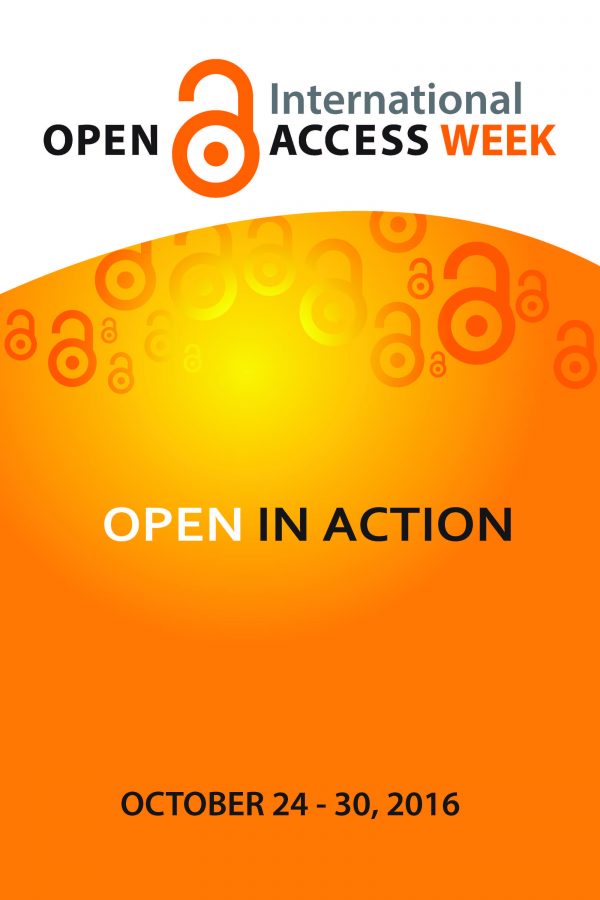
Recently, [i]n conjunction with this year’s Open Access Week Advisory Committee, SPARC [announced that] the theme for this year’s 9th International Open Access Week, to be held October 24-30, will be “Open in Action.”
International Open Access Week has always been about action, and this year’s theme encourages all stakeholders to take concrete steps to make their own work more openly available and encourage others to do the same. From posting pre-prints in a repository to supporting colleagues in making their work more accessible, this year’s Open Access Week will focus on moving from discussion to action in opening up our system for communicating research.

Established by SPARC and partners in the student community in 2008, International Open Access Week is an opportunity to take action in making openness the default for research—to raise the visibility of scholarship, accelerate research, and turn breakthroughs into better lives. This year’s Open Access Week will be held from October 24th through the 30th; however, those celebrating the week are encouraged to schedule local events whenever is most suitable during the year.
Read the entire SPARC announcement here
Curious about past Open Access Week events at UBC? Click here
Want to find other Open UBC resources? Click here
Above excerpt in italics is courtesy of SPARC and above photo is courtesy of JISC
Read More | No Comments