By cIRcle staff on Jul 29, 2016

Geographers study the natural and social processes that form our environments and interpret the changing interrelationships between environment and society. Geography courses examine the role of the natural environment in limiting and creating opportunities for people, and the role of society in reshaping the Earth habitat. The study of the natural environment itself, and the broad question of society’s relationship to nature, along with such concerns as the management of scarce resources and many environmental crises, have long been of interest to geographers. At UBC, the Geography undergraduate program is divided into three fields: physical, human, and technical. The Department offers a wide range of courses leading to a Bachelor of Science Degree in physical geography or a Bachelor of Arts Degree in human geography. Technical courses are incorporated into both degrees. At the graduate level, The Department of Geography at UBC is widely acknowledged as one of the leading departments in the world in terms of its research accomplishments. The scholarly interests of faculty members and graduate students encompass a wide range of subject areas, philosophical approaches, methods of analysis, and geographical locations.
Spanning a decade now, Dr. David Brownstein has “taught in the UBC Geography Department” and “supervised over 275 fourth-year projects, many of which you can now find online” in cIRcle, UBC’s Digital Repository.
With a special thanks to Dr. Brownstein and to all of his students including the community partners, it was a pleasure to archive the Department of Geography`s undergraduate research from 2011 to 2016. And, while the two GEOG 419 & GEOG 429 courses have ended indefinitely as of spring 2016, it is hoped that cIRcle can resume archiving and showcasing this unique undergraduate research output in the future.
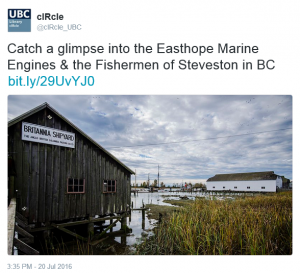
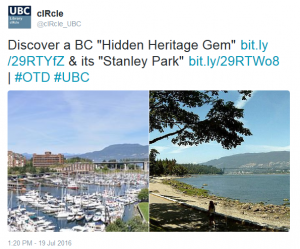
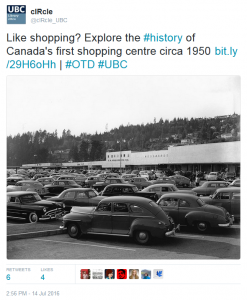
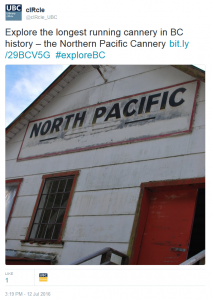
Until then, you can download the latest GEOG 419: Research in Environmental Geography and GEOG 429: Research in Historical Geography reports including some oral history interviews about various people and places located in and around British Columbia at: http://bit.ly/2an1DVn
Correction on August 9, 2016:
GEOG 419 is not cancelled but will be taught by a tenure track professor sans the community partners’ aspect due to the increase in the class size – 50 students”.
Above text excerpt in italics is courtesy of the UBC Department of Geography
Read More | No Comments
By cIRcle staff on Jul 12, 2016
Scholarship by academic librarians advances the fields of library and information science, influences practices of aligned professions, and informs effective advocacy. In support of broad and timely dissemination of library and information science scholarship, the Association of College and Research Libraries (ACRL) encourages academic librarians to publish in open access journals. When academic librarians choose to publish in subscription-based journals, ACRL recommends a standard practice of depositing the final accepted manuscript in a repository to make that version openly accessible. The author should be responsible for determining at what date the deposited manuscript becomes openly accessible, taking into account applicable institutional or funder policies, as well as other relevant considerations. ACRL further encourages academic librarians to make other forms of scholarship, such as monographs, presentations, grey literature, and data, openly accessible.
It is also imperative that publishers of library and information science scholarship explore and implement publishing models to make their content openly accessible as soon as possible. Librarians who are editors, reviewers, and authors should assist with this effort by engaging with their publishers about these models.
Read the full press release here
Find UBC Library research help here
Want to make your UBC research openly accessible? Visit cIRcle
Above image is licensed under the Creative Commons Attribution 3.0 Unported license
Read More | No Comments
By cIRcle staff on Jul 04, 2016

The Scholarly Communications and Copyright Office will be holding a series of Copyright Education workshops over the summer. Workshops will focus on author and creator rights; copyright in the classroom; copyright in the digital environment; copyright and conference presentations; and scholarly publishing, funding mandates, and open access. These workshops will be of particular interest to graduate students, faculty, instructional designers and anyone else who participates in research, scholarship and teaching at the post-secondary level.
Upcoming Copyright Workshops:
Navigating Copyright in the Digital Environment
Thursday, July 7 | 10-11am
Learn about what you can post on a UBC departmental site, social media platform and more
Register here
* * * * * * * * * * * * * * * * * * * * * * * * * * * * * * * * * * *
Copyright and the Ethics of Scholarly Publishing
Thursday, July 14 | 10-11am
Plagiarism? Academic integrity? “Self-plagiarism”? “Gift authorship”?
Find out what these terms mean and what you need to know to get your work out there ethically while preserving your own rights.
Register here
* * * * * * * * * * * * * * * * * * * * * * * * * * * * * * * * * * *
Author Rights, Funding Mandates, and Open Access Publishing
Thursday, July 21 | 10-11am
Curious about managing copyright in academic publishing?
Discover the different options available for open access publishing
Register here
Reserve your seat today!
Above image is courtesy of Pixabay and partial excerpt in italics is courtesy of UBC Library
Read More | No Comments
By cIRcle staff on Jun 15, 2016
Open data (scrabble) (Photo credit: justgrimes under this Creative Commons License)
High-quality data management is fundamental to research excellence. The ability to store, access, reuse and build upon digital data is critical to the advancement of research, supports innovative solutions to economic and social challenges, and holds tremendous potential for improvements in quality of life nationally and internationally.
As a step in this process, the agencies have developed the Tri-Agency Statement of Principles on Digital Data Management (the Statement). This builds on the 2013 consultation document, Toward a Policy Framework for Advancing Digital Scholarship in Canada, information provided by a Comprehensive Brief on Research Data Management Policies, and advice received through stakeholder engagement. The agencies sought feedback from the research community in summer 2015 on a draft version of the Statement.
The Statement of Principles on Digital Data Management outlines the agencies’ overarching expectations with regard to digital research data management, and the responsibilities of researchers, research communities, institutions and funders in meeting these expectations. It complements and builds upon existing agency policies, and will serve as a guide to assist the research community in preparing for, and contributing to the development of, Tri-Agency data management requirements. The HTML version is accessible here.
Read the full press release here
See The Tri-Agency Open Access Policy: How the UBC Library Can Help guide for UBC researchers
Read More | No Comments
By cIRcle staff on Jun 13, 2016

A Vancouver-born biomedical researcher who is a pioneer in experimental medicine with an established track record as a senior leader at U.S. universities has become the 15th President and Vice Chancellor of the University of British Columbia, the university announced today at the Peter A. Allard School of Law on the Vancouver campus.
Since 2012, Dr. Santa Jeremy Ono has served as the President of the University of Cincinnati (UC) in Cincinnati, Ohio. Prior to that, he served as the Senior Vice President for Academic Affairs and Provost at UC. Under his leadership, UC achieved its largest enrollment in its history and received numerous accolades, including being named Public University of the Year by the Washington Center.
“I am greatly humbled by the opportunity to lead one of the world’s greatest universities,” said Ono. “UBC attracts the best and brightest faculty and students. It is uniquely positioned on the Pacific Rim and boasts one of the most diverse and sustainable campuses. I relish the opportunity to help UBC realize its aspirations and destiny as a truly global university.”
For Ono, returning to UBC is a homecoming of sorts. His father, Takashi Ono, is an accomplished mathematician, who formerly taught as a faculty member in UBC’s Math Department, which explains how Ono came to be born at St. Paul’s Hospital just 20 minutes away. His father is also a gifted pianist, who passed on his love of music to his son, who himself plays the cello.
Read the full UBC Public Affairs’ media release here
Read Dr. Santa Ono’s full biography here
Watch the
Above partial texts in italics and photo are courtesy of UBC Public Affairs
Read More | No Comments